By Timothy Hales | Updated: December 14, 2022
Yes. The TSA allows chef knives on a plane as long as they’re in your checked bag — not your carry-on. Wrap or sheath the blade so it can’t injure anyone inspecting your luggage. That’s the short answer. Everything else below is for people who want to do this right.
Why would I want to travel with my chef’s knife?
Vacation kitchen knives are almost universally terrible. I’ve stayed in enough Airbnbs and hotel suites to know that whatever knife is sitting in that drawer has no business being near food you care about. You’re either wrestling a dull serrated blade through a tomato or trying to break down a chicken with something that feels like a butter knife. If you’re cooking real meals on a trip — not just reheating — bringing your own knife is genuinely worth the minor inconvenience.
That said, it’s not always the right call. A weekend trip where you might make one dinner? Probably not worth it. A week-long stay with a full kitchen where you’re cooking daily? Absolutely bring it.
Do you have to declare knives in checked luggage?
No declaration required in the United States. Put it in your checked bag, packed properly, and you’re done.
If you’re flying internationally, that changes. Some countries have strict knife laws that apply even to kitchen knives, and customs enforcement varies wildly. Before you travel abroad with a knife, spend five minutes checking the entry rules for your destination country. It’s not something to assume on.
How should I pack my chef’s knife?
The goal is simple: the blade needs to be fully covered and the knife shouldn’t be able to move around and damage itself or cut through whatever’s wrapped around it. Here are the four methods, in order of how much I’d actually recommend them:
1. Knife roll bag
If you travel with knives more than once or twice a year, just get a roll bag. They hold multiple knives, keep everything separated and protected, and make you look like you know what you’re doing when you unpack at your destination. Leather and canvas are both durable options. They close with clips or buckles and roll tight enough that nothing shifts in transit.
This is what chefs use for a reason — it’s the best solution if you’re bringing more than one knife.
2. Knife sheath or BladeSafe case
For a single knife, a blade sheath or hard case is the cleanest option. Some chef knives come with one. If yours didn’t, they’re cheap to buy separately. I use a Victorinox BladeSafe case when I take my knife to other people’s houses or on trips — it fits most standard chef knife blades, snaps securely, and takes up almost no space in a bag.
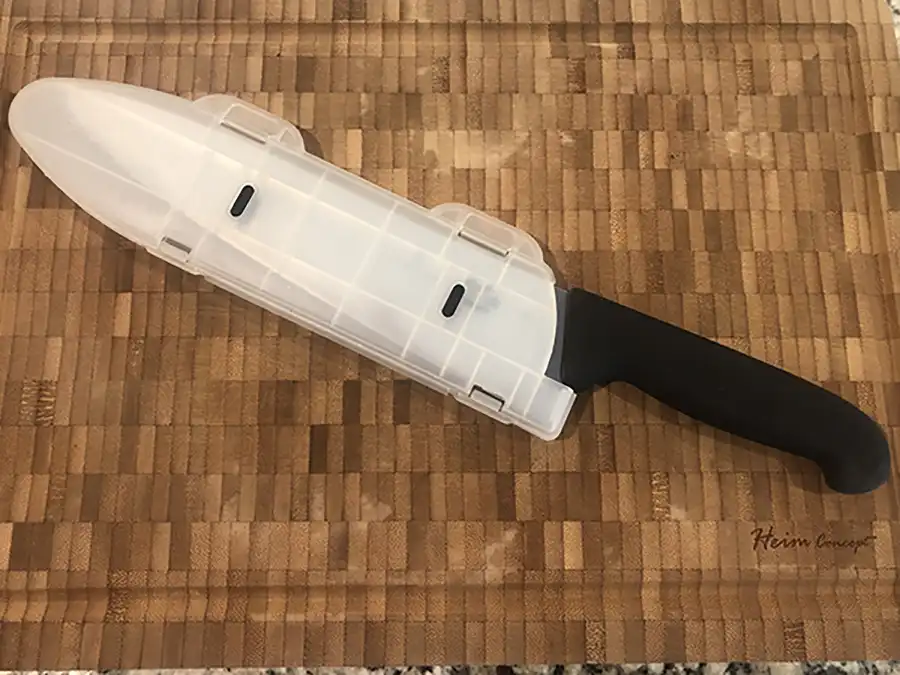
If you already have a sheath, wrapping it in a dish towel on top of that adds another layer of protection.
3. Knife edge guards
Edge guards slip over the blade and protect the cutting edge specifically. They’re lightweight and inexpensive, and they work well if you’re not worried about the spine or tip getting dinged. Make sure you buy the right length for your knife — a guard that’s too short leaves part of the blade exposed.
4. Wrap or bundle in a dish towel
The no-gear option that works fine when you’re not packing a roll bag. Here’s how to do it properly:
- Lay a large dish towel flat on the counter
- Place your knife (or knives) on it with space between them
- Roll the first knife into the towel completely before rolling in any others — leave extra material at the tip end
- Fold the towel over the tips, then secure both ends with rubber bands
The key mistake people make here is rolling too tight without enough material at the tips. The tip is the most vulnerable part and the most likely to poke through. Give it extra coverage.
A few things to consider when choosing your packing method:
- Bringing more than one knife? Use a roll bag or the towel-bundle method — edge guards don’t work well for multiple knives together
- Traveling often with your knives? Invest in a roll bag or a dedicated case. The towel method is fine occasionally but gets tedious
- Packing with clothes? A sheathed knife tucked between soft layers is low-risk. If you’re packing with hard items or other gear, add more protection
It is essential to pack your kitchen knives properly to provide safety to those handling them and to prevent damage to your knives. The tip and blade of the knife should be completely covered so that there is no accidental stab or cut of yourself or someone inspecting your baggage. The chef’s knife should have little room to move around in the packaging or case. When packing your knives, you should consider whether you take a single chef knife or take several knives with you on your trip.
There are four different methods for packing your knives:
- Kitchen knife roll bag
- Knife edge guards
- Chef’s knife cover, sheath, or case
- Wrapping and Bundling
There are several methods for packing your knives. When deciding which one is best for your situation, you should consider the following:
- How many knives will you be taking? If you take more than one knife, you should consider using a knife roll bag or use the wrap or bundle method.
- Will you be traveling often with your knives? If you regularly travel with your knives, then it would be best to invest in a knife roll bag or some type of edge guard, sheath, or case. Bundling is easy to do with everyday household items, but it can be time-consuming if you do it before each trip.
- What will you be packing with your knife? If you are packing your knife in a suitcase with your clothes, it is easy to place a single knife in-between a layer of clothing to add protection. However, if you are packing your knife in a suitcase with other hard or metal items, you will want to add additional protection around your knives, such as bundling or a roll bag.
Chef’s knife sheath or case
Some chef knives come with a sheath that you could use when traveling. Usually, the sheath fits over the blade and locks in to place. You can also purchase a case that will cover the chef’s knife blade. You can also bundle a chef’s knife in a sheath or case in a towel to provide additional protection.
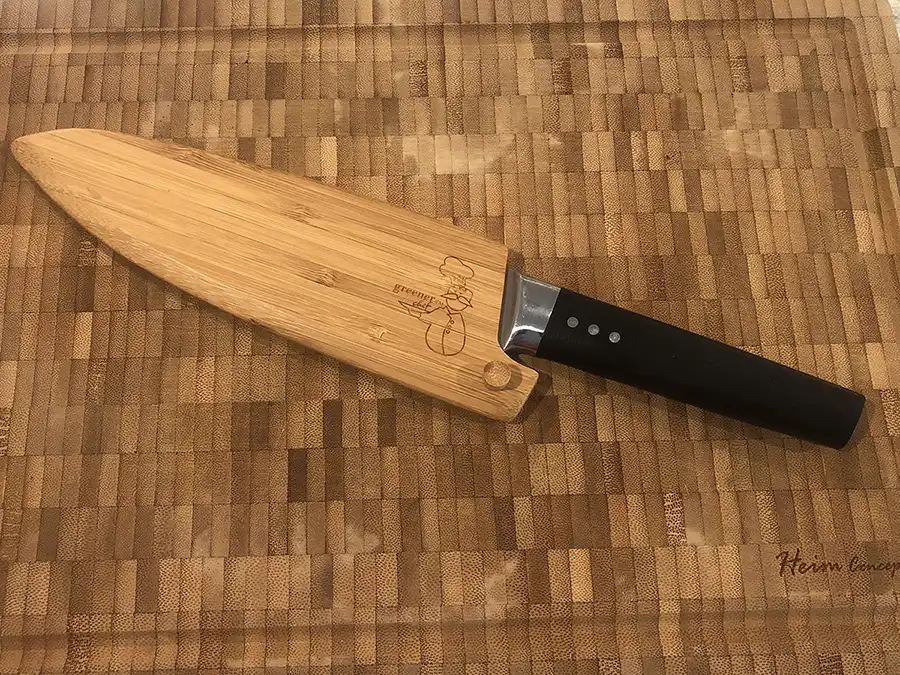
For example, I use this Victorinox BladeSafe case when I take my knife to other people’s houses or on vacation.
Wrap or bundle your knife
You can wrap or bundle your kitchen knives using a dishtowel or heavy-duty packing paper. This method allows you to wrap one or more knives together easily. The key here is to make sure that the towel or paper you are wrapping them in is thick enough to protect the blade’s tip edge. As you wrap the knives, leave enough space to completely cover each knife before being bundled up against another knife. Allowing extra material between knives will make sure that they do not bang together and damage each other. Once you have entirely wrapped your knives, you can use a rubber band or packing tape to keep the bundle tight.
Steps for wrapping your chef knives in a dishtowel:
- Place a large dishtowel on the counter in which to wrap knives.
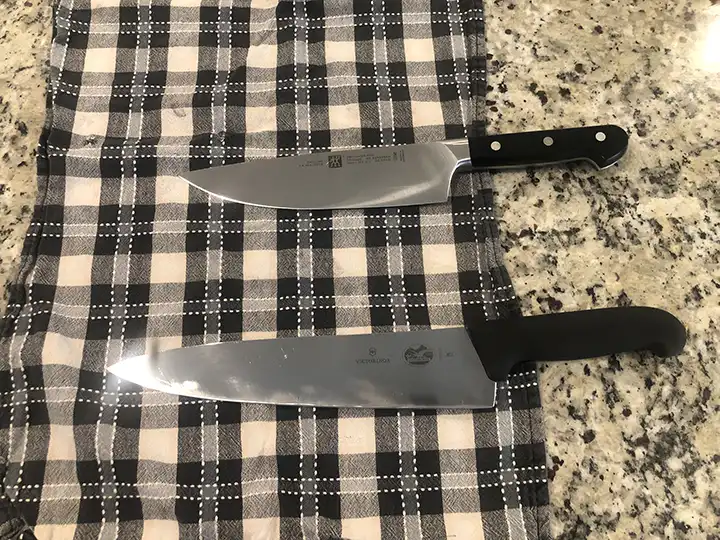
- Place knives on the dishtowel, leaving space between each.
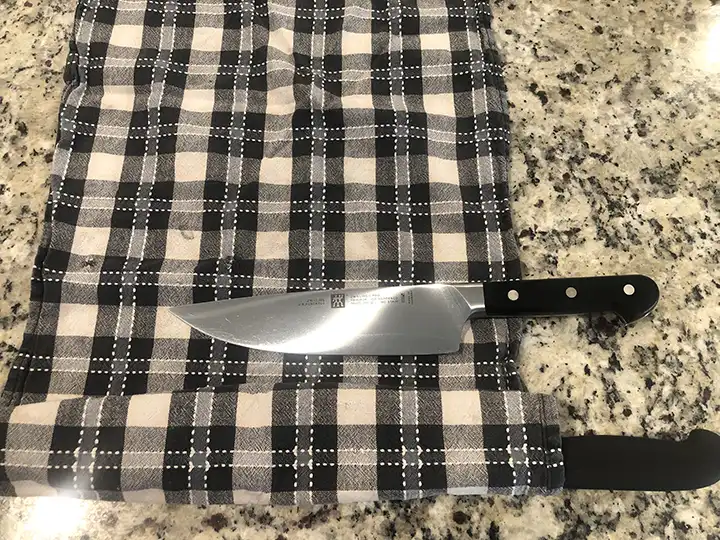
- Begin rolling the first knife in the dishtowel, and roll the second knife in the towel after you have completely covered the first knife. When rolling in the dishtowel, be sure to leave extra material at the end to fold over the tips.
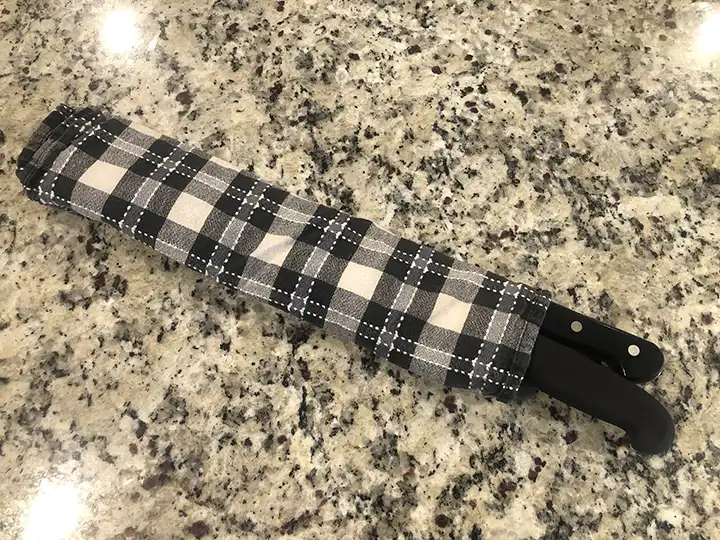
- Fold the towel over the tips and place a rubber band around each end of the bundle.
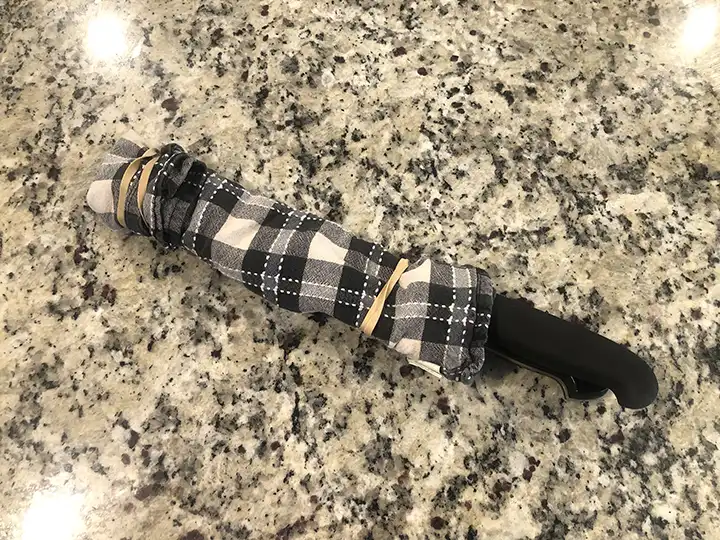
What other option do I have if I do not want to put my chef knives in my checked luggage?
If you are traveling with some expensive chef’s knives, then you may not want to put them in your checked luggage for fear of them getting damaged or stolen. You can use USPS, FedEx, or UPS to send your knives overnight or to your destination. Many hotels and resorts have package holding services, but you should always check with them before sending your knives. If you plan to ship your knives, you should follow the same packing tips as if you were putting them in your checked luggage.
What types of kitchen knives are okay to take in my carry-on bag?
The TSA allows plastic or flat rounded butter knives to be in your carry-on luggage.
What happens if I forget to take my chef knife out of my carry-on bag?
If you forget to take out your knife before reaching the airport checkpoint, you may encounter a few delays, but you shouldn’t have any criminal enforcement action towards you unless you have a meat cleaver. Carrying a meat cleaver can result in a fine of up to $2,090. Here is a list of allowed and prohibited items from the TSA.
If you are caught with your chef’s knife at the checkpoint, you have four options other than surrendering it to the TSA:
- Put it in a checked bag.
- Give it to the friend or relative who brought you to the airport.
- Take it back to your parked car.
- Use a mailer to ship it back home.
Final Notes
If you have any concerns with taking your kitchen knives on an airplane, it is always best to call the airline directly to confirm that you can take the knives on the airplane in checked luggage and the recommended way to secure them in your bag. Also, if you are flying internationally, then you will need to check in to local laws as some countries forbid carrying knives of any type.